

Automated Ophthalmic Perimeters Market is expected to reach US$ 389.52 Million by 2033 | DataM Intelligence
Automated Ophthalmic Perimeters Market
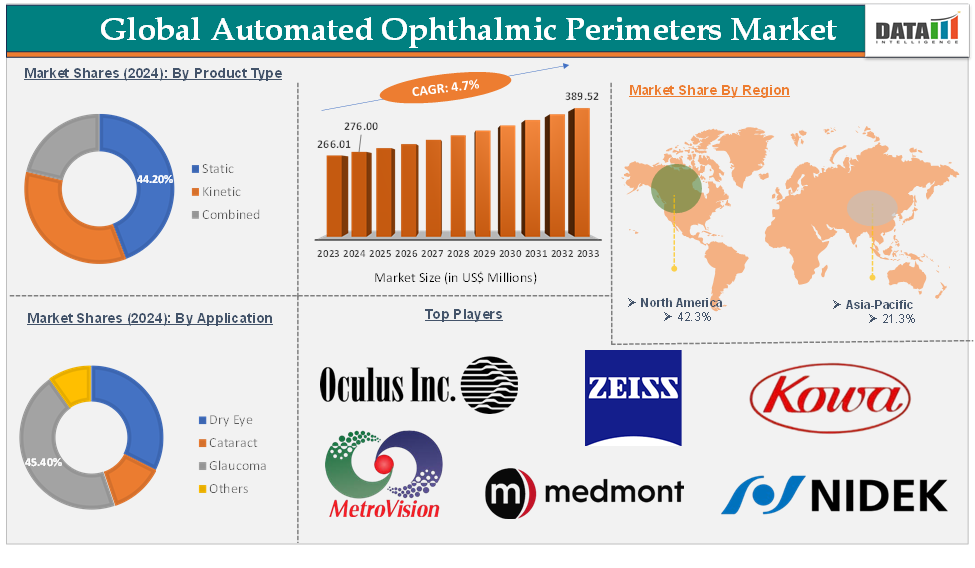
The Global Automated Ophthalmic Perimeters Market is expected to reach at a CAGR of 4.7% during the forecast period 2025-2033.
The Automated Ophthalmic Perimeters Market is witnessing rapid growth, driven by rising eye disorders, advanced diagnostics, and increased adoption of AI-powered solutions.”
AUSTIN, TX, UNITED STATES, February 4, 2026 /EINPresswire.com/ -- Market Overview:— DataM Intelligence
The Automated Ophthalmic Perimeters Market has emerged as a crucial segment within the broader ophthalmic devices industry, driven by the increasing prevalence of vision disorders such as glaucoma, macular degeneration, and diabetic retinopathy. Automated ophthalmic perimeters are advanced diagnostic instruments designed to assess a patient’s visual field with precision, speed, and greater repeatability compared to traditional manual perimeters. These devices incorporate sophisticated software and imaging technologies that help eye care professionals identify and quantify visual field loss, enabling early intervention and improved treatment outcomes. As awareness of preventive eye care rises alongside global aging populations, demand for automated perimetry solutions continues to grow across hospitals, eye clinics, diagnostic centers, and research institutions.
To Download Sample Report Here: https://www.datamintelligence.com/download-sample/automated-ophthalmic-perimeters-market
According to DataM Intelligence, The Global Automated Ophthalmic Perimeters Market was valued at USD 276.00 million in 2024 and is expected to reach USD 389.52 million by 2033, representing a CAGR of approximately 4.7% over the forecast period. Market growth is fueled by key drivers such as advanced technology adoption, rising incidence of visual impairments, and increasing healthcare expenditure in developed and emerging economies. Among the segmentation categories, static automated perimeters account for the largest revenue share, attributed to their widespread clinical acceptance and high diagnostic accuracy in detecting peripheral vision deficits. Geographically, North America stands as the dominant regional market, supported by strong healthcare infrastructure, robust reimbursement systems, and presence of leading manufacturers investing in research and development.
Key Highlights from the Report:
The Global Automated Ophthalmic Perimeters Market is projected to register a CAGR of 4.7% from 2025 to 2033.
Static perimeters lead the product type segment, driven by superior diagnostic performance.
Hospital and clinic end-users contribute the highest revenue share due to high patient volumes.
North America dominates regional revenue, followed by Europe and the Asia Pacific.
Technological advancements such as AI-integrated perimetry enhance market growth potential.
Rising prevalence of glaucoma and diabetic eye diseases boosts demand for automated visual field testing.
Market Segmentation:
The Automated Ophthalmic Perimeters Market is segmented by product type, technology, end-user, and geography to reflect diverse application areas and customer needs. Based on product type, the market is divided into static perimeters, kinetic perimeters, and bowl perimeters. Static perimeters hold the largest share due to their non-invasive methodology and ability to accurately map subtle visual field defects. Kinetic perimeters, while still relevant for specific clinical use cases, trail static devices in adoption rate. Bowl perimeters, which offer 3D visual field testing, are gaining traction as technological improvements lower costs and increase accessibility.
In terms of technology, segmentation includes software-integrated systems, touch-screen interfaces, and AI-powered perimetry solutions. Software-enhanced and AI-integrated perimeters provide automated interpretation of test results, enabling faster clinical decisions and reducing dependency on specialist operators. These advanced technologies are appealing to large healthcare facilities aiming to improve workflow efficiency. Segmenting by end-users reveals that hospitals and eye care clinics account for the majority of market revenue, owing to their extensive patient base and the need for comprehensive ophthalmic diagnostic equipment. Diagnostic centers and research institutions are also significant contributors, especially where visual field testing is essential for clinical studies and screening programs.
Speak to Our Analyst and Get Customization in the report as per your requirements: https://www.datamintelligence.com/customize/automated-ophthalmic-perimeters-market
Regional Insights:
The Automated Ophthalmic Perimeters Market exhibits significant regional variation in adoption, growth rates, and competitive intensity. North America leads the market, with the United States and Canada showing high utilization of advanced ophthalmic diagnostic devices. Factors such as well-established healthcare infrastructure, favorable reimbursement policies, and a high incidence of age-related vision disorders contribute to the region’s market leadership. Additionally, strong presence of major manufacturers and continuous innovation in perimetry technology support sustained demand.
Europe holds the second-largest share, buoyed by government initiatives promoting eye health and early disease detection. Countries such as Germany, the United Kingdom, and France are notable markets where routine visual field testing is an integral part of ophthalmic care. Although Europe’s market growth rate is slightly lower than North America’s due to variable reimbursement structures across countries, the region is expected to maintain steady expansion.
The Asia Pacific region is anticipated to register the fastest growth during the forecast period. Rapid urbanization, increasing healthcare spending, and growing patient awareness in countries like China, India, and Japan are key growth drivers. Furthermore, expanding healthcare infrastructure in emerging markets is facilitating greater access to automated diagnostic equipment, making ophthalmic perimeters more accessible beyond metropolitan centers. Latin America and the Middle East & Africa represent smaller, though gradually growing, markets where investments in eye care services are generating new demand for automated perimetry.
Market Dynamics:
Market Drivers
Several factors are driving the growth of the automated ophthalmic perimeters market. Rising prevalence of visual impairments, particularly in aging populations, underscores the need for early and accurate diagnosis. Conditions such as glaucoma, which often progress asymptomatically until advanced stages, require routine visual field assessments that automated perimeters can efficiently perform. In addition, technological advancements, including AI integration, user-friendly interfaces, and cloud connectivity, are enhancing the clinical utility and appeal of these devices. Increased healthcare expenditure in both developed and emerging economies enables hospitals and specialty clinics to invest in advanced diagnostic tools. Finally, heightened awareness of eye health and preventive screening programs is encouraging patients to seek timely eye examinations, further boosting market demand.
Market Restraints
Despite strong growth prospects, the market faces certain restraints. High upfront costs and maintenance expenses associated with advanced automated perimeters may limit adoption, particularly in small clinics and budget-constrained healthcare settings. In addition, lack of trained personnel to operate sophisticated perimetry systems can be a barrier in regions with limited specialized workforce. Regulatory hurdles and varying reimbursement policies across countries also pose challenges that can slow product uptake. Furthermore, competition from alternative diagnostic modalities, such as optical coherence tomography (OCT), which provides complementary structural information of the retina, may shift market focus away from standalone perimetry in some clinical scenarios.
Market Opportunities
The Automated Ophthalmic Perimeters Market presents ample opportunities for growth and innovation. Integration of artificial intelligence and machine learning algorithms into perimetry systems can improve diagnostic accuracy, predictive analytics, and personalized patient care. Cloud-based data management and telemedicine-enabled perimeters are emerging as valuable solutions in remote and underserved regions, expanding the reach of eye care services. Partnerships between device manufacturers and healthcare providers can facilitate bundled solutions that enhance clinical workflows and improve patient outcomes. Additionally, rising investments in vision care initiatives by governments and non-profit organizations present opportunities for large-scale screening programs that leverage automated perimetry as a core diagnostic tool.
Looking For Full Report? Get it Here: https://www.datamintelligence.com/buy-now-page?report=automated-ophthalmic-perimeters-market
Frequently Asked Questions (FAQs):
What is the current size of the Automated Ophthalmic Perimeters Market?
How big is the automated ophthalmic perimeters market forecast through 2032?
Who are the key players in the Global Automated Ophthalmic Perimeters Market?
What factors are driving adoption of Automated Ophthalmic Perimeters?
Which region is estimated to dominate the Automated Ophthalmic Perimeters Market during the forecast period?
Company Insights:
Carl Zeiss
Occulus Inc
Metro Vision
Kowa Company, Ltd.
Medmont
Nidek Co., Ltd.
Essilor Instruments
Haag Streit
Optopol Technology
Topcon Corporation
OCULUS
FREY
TOMEY GmbH + RODENSTOCK Instruments
iCare
Recent Developments:
United States:
January 2026: Partnerships between US tech firms and eye clinics expanded teleophthalmology applications for remote perimeter testing amid rising demand.
December 2025: Leading hospitals in the US integrated next-gen perimeters featuring faster testing protocols, reducing patient wait times by 30% in outpatient settings.
November 2025: A major US ophthalmic device manufacturer launched an AI-enhanced automated perimeter with improved glaucoma detection accuracy, gaining FDA clearance for wider clinical adoption.
Japan:
January 2026: Japanese firms collaborated on AI-driven perimeters, focusing on early diabetic retinopathy screening in community health centers.
December 2025: Topcon Corporation upgraded its perimeter lineup with kinetic-static hybrid models, approved by PMDA for hospital deployment.
November 2025: Rexxam introduced the FIELDNavigator automated perimeter, enhancing visual field analysis with advanced automation tailored for Japan's aging population.
Unlock 360° Market Intelligence with DataM Subscription Services: https://www.datamintelligence.com/reports-subscription
Conclusion:
In summary, The Automated Ophthalmic Perimeters Market is poised for robust growth, driven by rising prevalence of vision disorders, technological innovation, and expanding healthcare infrastructure worldwide. With North America currently leading in market adoption and the Asia Pacific region emerging as a high-growth frontier, manufacturers and healthcare providers alike are focusing on delivering advanced, user-friendly perimetry solutions. While cost and training barriers remain challenges, ongoing investments in AI and telemedicine present significant opportunities. As demand for precise and efficient visual field assessment continues to rise, automated ophthalmic perimeters will remain a vital component of modern eye care diagnostics.
Related Reports:
Cataract Surgery Devices Market
Electrosurgical Pencils Market
Sai Kiran
DataM Intelligence 4Market Research
+1 877-441-4866
Sai.k@datamintelligence.com
Visit us on social media:
LinkedIn
X
Legal Disclaimer:
EIN Presswire provides this news content "as is" without warranty of any kind. We do not accept any responsibility or liability for the accuracy, content, images, videos, licenses, completeness, legality, or reliability of the information contained in this article. If you have any complaints or copyright issues related to this article, kindly contact the author above.
